
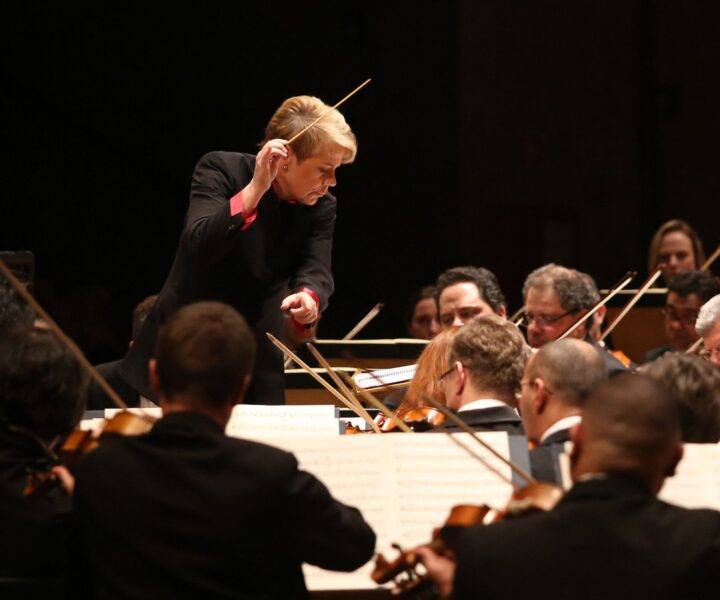
Maestra Marin Alsop made her return to São Paulo after three years to conduct the São Paulo Symphony Orchestra (OSESP), where she served as Music Director and Principal Conductor from 2011-2019 and Honorary Conductor from 2020-2023, becoming the first woman to do so. Titled “Historias de Amor,” the program presented works spanning her career and longstanding relationship with the orchestra.
The sold-out performances took place September 17-19, 2026, at the iconic Sala São Paulo and featured special narration highlighting Alsop’s career and impact in São Paulo and around the world.
Read the English translation of the concert transcript below.
SCRIPT
MARIN ALSOP SPECIAL — 70 YEARS
SÃO PAULO SYMPHONY ORCHESTRA (OSESP)
September 17, 18, and 19, 2026 / Sala São Paulo
FIRST PART OF THE CONCERT
Welcome to Sala São Paulo. This evening/afternoon, we shall pay tribute to a person of great importance in the history of the orchestra.
The year was 2012, and the São Paulo Symphony Orchestra, little more than a decade after its restructuring, welcomed Marin Alsop as the ensemble’s Principal Conductor. It was a bold choice at a time when major orchestras rarely engaged women to lead them. For the American conductor, it represented an important step in a career marked by challenges.
Marin Alsop’s life has been marked by a pioneering spirit. Trained as a violinist, in 1984, at the age of 28, she founded her own orchestra — the only means she found of securing an opportunity to conduct. It was a difficult beginning, until, five years later, recognition arrived: she won the Koussevitzky Conducting Prize, awarded by the venerable Tanglewood Music Center. It was the first time a woman had received the prize, and, moreover, she would come to know Leonard Bernstein, one of the most important musical figures of the twentieth century, who would become her mentor.
Alsop began to attract international attention in 2007, upon assuming the music directorship of the Baltimore Symphony Orchestra — the first time a woman had led a major American orchestra. Still in 2012, only a few months after taking up her post at Osesp, she led the ensemble on its fourth European tour. The opening concert made history with the orchestra’s debut at the BBC Proms, one of the world’s most important classical music festivals, performing before an audience of some six thousand people at the Royal Albert Hall in London. Following engagements in England, Germany, and the Netherlands, Osesp, under Marin Alsop’s baton, was named by European critics as one of the leading orchestras on the international circuit.
Our conductor is the daughter of professional musicians and was cradled, from birth, by the music her parents’ friends played at home. Yet the most significant memory of her childhood was attending one of the “Young People’s Concerts” with the New York Philharmonic and Leonard Bernstein — long, therefore, before her professional encounter with the maestro. Marin Alsop retained no memory of the music performed, only the impact of Bernstein’s presence. She experienced a kind of revelation and, at nine years of age, told her father: “I am going to be a conductor.”
[Music] BERNSTEIN Candide: Overture
In 2013, one year after her arrival at the São Paulo Symphony Orchestra, Marin Alsop also became the ensemble’s Music Director, leading it on its fifth European tour, with performances in thirteen cities across six different countries.
For her, becoming Osesp’s Music Director meant greater involvement in musical matters, such as repertoire, and in matters concerning the musicians themselves; that is, she developed a closer bond with, and a greater responsibility toward, the orchestra.
The tours, for their part, were moments of great learning. As the conductor puts it: “The simple fact of playing in different halls is excellent; it makes the musicians far more flexible.” Moreover, Marin Alsop has always considered it important for the world to see that Brazil has an orchestra of this caliber.
Under her baton, Osesp made its debut at the Berlin Philharmonie, London’s Royal Festival Hall, and the Vienna Konzerthaus. It also toured Brazil in 2014, celebrating the orchestra’s sixtieth anniversary.
For Marin Alsop, however, Sala São Paulo remains a unique place. In her own words: “I love working in this hall. It is beautiful, and our audience is extraordinary.” Among the many concerts she has conducted here, performing Mahler’s music with Osesp has always been a special occasion.
[Music] MAHLER Symphony No. 5: Adagietto
Ever since she decided to pursue a career in orchestral conducting, Marin Alsop has broken new ground — and continues to do so today, at the age of 70. With Osesp, she also became, in 2013, the first woman to conduct the “Last Night” of the Proms, the venerable London festival. And, in 2019, she was honored at the World Economic Forum in Davos for her leadership in promoting diversity in music.
All of this pioneering work carries with it a responsibility, one she readily embraces: she likes to say that, while honored to be the first, what truly interests her is knowing who the second and third women will be to occupy such positions of power.
Speaking of pioneering achievements, in 2011 Osesp carried out its first live concert broadcast. At the helm of the orchestra, then still a guest conductor, was Marin Alsop. Under her direction, the orchestra performed Sergei Prokofiev’s Symphony No. 5. It was a harbinger of things to come: in 2012, Osesp launched an ambitious recording project in partnership with the Naxos label to record the complete Prokofiev symphonies — conducted, naturally, by our own maestra.
Discreet and measured in speech, it is on the podium that Marin Alsop allows her emotions to flow freely. For her, “being on stage is about existing fully in that moment, being intensely focused, almost in a trance. It is liberating.”
[Music] PROKOFIEV Romeo and Juliet: Selection
———Intermission———
SECOND PART OF THE CONCERT
In 2016, under Marin Alsop’s direction, the São Paulo Symphony Orchestra took part in three of the most important European summer festivals: the Edinburgh International Festival, in Scotland; the Lucerne Festival, in Switzerland; and, once again, the BBC Proms, in England. Then, in February 2019, Osesp undertook a tour of China, making history as the first professional Latin American orchestra to tour the country. Conducted by Marin Alsop, the ensemble performed in Shanghai, Jinan, Beijing, and Hong Kong.
When she was accepted at Tanglewood as a conducting fellow, Marin Alsop was already 32 years old and knew she had to seize that opportunity by any means necessary. She was ultimately selected to conduct a concert with Leonard Bernstein, on the occasion of his seventieth birthday. Beyond opening the doors to her conducting career, her contact with Bernstein was crucial in helping Marin Alsop trust in herself. “I believe in you,” she heard from the maestro, with whom she went on to study in New York.
Mindful of the importance of such opportunities, and concerned with the musical education of future generations, Marin Alsop established the Conducting Academy here at Osesp. Marking its tenth anniversary in 2026, the program offers an environment of intensive training for young musicians seeking to hone their craft in the field.
Over the years, Marin Alsop has delved ever deeper into the music of Leonard Bernstein and is today regarded as a leading authority on the subject. In 2019, the Naxos label released an eight-CD box set in which she conducts a substantial portion of Bernstein’s symphonic works. A number of these recordings were made with Osesp, including the overture to Candide and excerpts from West Side Story.
[Music] BERNSTEIN Symphonic Dances from “West Side Story”
2019 marked Marin Alsop’s final year as Osesp’s Principal Conductor and Music Director. At the season’s closing concert, which also served as the conductor’s farewell, the orchestra premiered the project “All Together — A Global Ode to Joy,” in partnership with Carnegie Hall. Beethoven’s Ninth Symphony was performed at Sala São Paulo in an unprecedented version, sung in Portuguese.
After eight years at the helm of the orchestra, Marin Alsop became our Conductor Laureate. Under her direction, the orchestra refined its artistic level and strengthened its international presence through acclaimed recordings and tours. The conductor believes her greatest contribution was shaping Osesp’s collective sound.
Yet if Osesp was transformed during the years under her direction, Marin Alsop, too, left here a changed artist. With a career of even greater renown, she has become an influential voice in the world of classical music, whether on the subject of music education for children or in discussions surrounding gender equality.
As Conductor Laureate, she has continued to work with the orchestra. In 2022, Osesp made its debut at the legendary Carnegie Hall, presenting, under her baton, the production “Floresta Villa-Lobos,” which combines Brazilian music with an immersive video projection by artist Marcello Dantas, portraying the richness of the country’s flora and fauna.
During the years she was regularly with us, Marin Alsop sampled the variety of our cuisine and, together with her family, traveled on holiday throughout Brazil, visiting the Amazon, Bahia, and Mato Grosso do Sul. She also became acquainted with the music of Brazilian composers and came to love and admire Villa-Lobos.
Marin cares little for the “honeymoon phase.” For her, love affairs with her orchestras are not fleeting initial passions that soon fade, but experiences built on long and dedicated work. The relationship grows stronger with time — and it is then, indeed, that love truly blossoms.
[Music] VILLA-LOBOS Chôros No. 10
ENCORE: LOBO, Edu — Suíte Popular Brasileira: Pé de Vento
END